
In industrial UV printing, print accuracy, operating speed, and long-term stability depend not only on the printhead and ink supply system but also on a key component that is often overlooked: the print carriage drive system.
Currently, two common drive solutions are used in industrial printing equipment: magnetic levitation linear motor drives and traditional mechanical transmission systems, such as ball screws and belt drives.
But is a magnetic levitation linear motor always better than traditional transmission? For industrial customers seeking higher production efficiency, which solution offers a better long-term investment?
Based on the actual configurations of Hanrun Paper's UV-H2513, UV-H9060, and Super A-808, this article compares the two technologies in terms of operating principles, performance, maintenance costs, and application scenarios to help you choose the right equipment for your production needs.
Traditional non-linear motor systems typically rely on mechanical components such as screws or belts to convert rotary motion into linear motion.
A magnetic levitation linear motor, however, generates linear thrust directly to move the print carriage along its guideway. It does not require traditional screws or belts to transmit power.
This design reduces intermediate mechanical transmission components and helps minimize the effects of mechanical backlash, friction, and wear associated with conventional drive systems.
Its main advantages include:
✅Reduced transmission errors: Eliminates the need for traditional screw or belt transmission, reducing the impact of mechanical backlash on positioning.
✅Fast response: Direct-drive technology supports rapid acceleration, deceleration, and precise positioning.
✅Smooth operation: Fewer mechanical contact points and less transmission friction help reduce vibration during operation.
✅Better long-term accuracy retention: Reduced wear on traditional transmission components helps maintain positioning accuracy over extended operation.
For large-format printing, high-precision applications, and continuous production, magnetic levitation linear motors provide a more advantageous foundation for motion control.
Here, traditional non-linear motor systems refer mainly to conventional motors combined with screw or belt mechanisms to achieve linear movement.
The operating process is straightforward: the motor generates rotary power, which is transmitted through a screw or belt to move the print carriage along a designated path.
Their main characteristics include:
✅Mature technology: Mechanical transmission systems have been widely used and validated in practical applications.
✅Controllable costs: Configurations can be adjusted according to equipment positioning and production requirements.
✅Straightforward maintenance: Screws and belts can be inspected, adjusted, or replaced according to actual operating conditions.
✅Wide application range: Suitable for a variety of conventional printing production requirements.
| Comparison | Magnetic Levitation Linear Motor | Traditional Screw/Belt Drive |
|---|---|---|
| Motion accuracy | No traditional mechanical transmission backlash, supporting high-precision positioning | Affected by mechanical backlash, assembly accuracy, and component wear |
| Operating speed | Fast response and strong acceleration/deceleration performance | Depends on screw or belt specifications and overall structural design |
| Maintenance costs | Fewer mechanical transmission components subject to wear, reducing related maintenance requirements | Requires periodic inspection, adjustment, or replacement of transmission components |
| Noise and vibration | Fewer mechanical contact points and less transmission friction help reduce noise and vibration | Mechanical transmission may generate friction and vibration |
| Long-term stability | Reduces the impact of transmission component wear on positioning accuracy | Long-term performance depends on component quality, maintenance, and operating conditions |

The UV-H2513 features a magnetic levitation linear motor drive system and a large-format printing platform measuring 2500 × 1300 mm, providing a stable motion control foundation for industrial production.
Its main configurations and advantages include:
✅High-speed printing
✅Four-zone independent vacuum control system
✅Dual negative-pressure ink supply system
✅Automatic height detection system
✅Material compatibility: Supports printing on materials up to 150 mm thick
For applications such as advertising signage, industrial panels, and decorative materials, the UV-H2513 combines large-format printing capabilities with magnetic levitation linear motor technology, helping businesses balance production efficiency and print quality.

Unlike conventional flatbed UV printers, the UV-H9060 is designed to meet the needs of 3D objects and multiple printing applications.
Its X and Z axes use a dual screw drive structure with THK dual linear guide rails. It can also be equipped with an optional magnetic levitation linear motor, achieving repeat positioning accuracy of up to 0.1 mm.
Beyond its drive system, the UV-H9060 offers several features designed for practical production requirements:
✅Intelligent visual positioning system
✅Platform lifting height of up to 50 cm
✅Ricoh G6 printheads: Support a maximum printhead-to-substrate distance of 15 mm
✅Multi-application printing: Supports flatbed, cylindrical, roll-to-roll, and 3D object printing
The Super A-808 is designed for professional DTF printing applications. In addition to print quality, it focuses on convenient maintenance throughout long-term production.
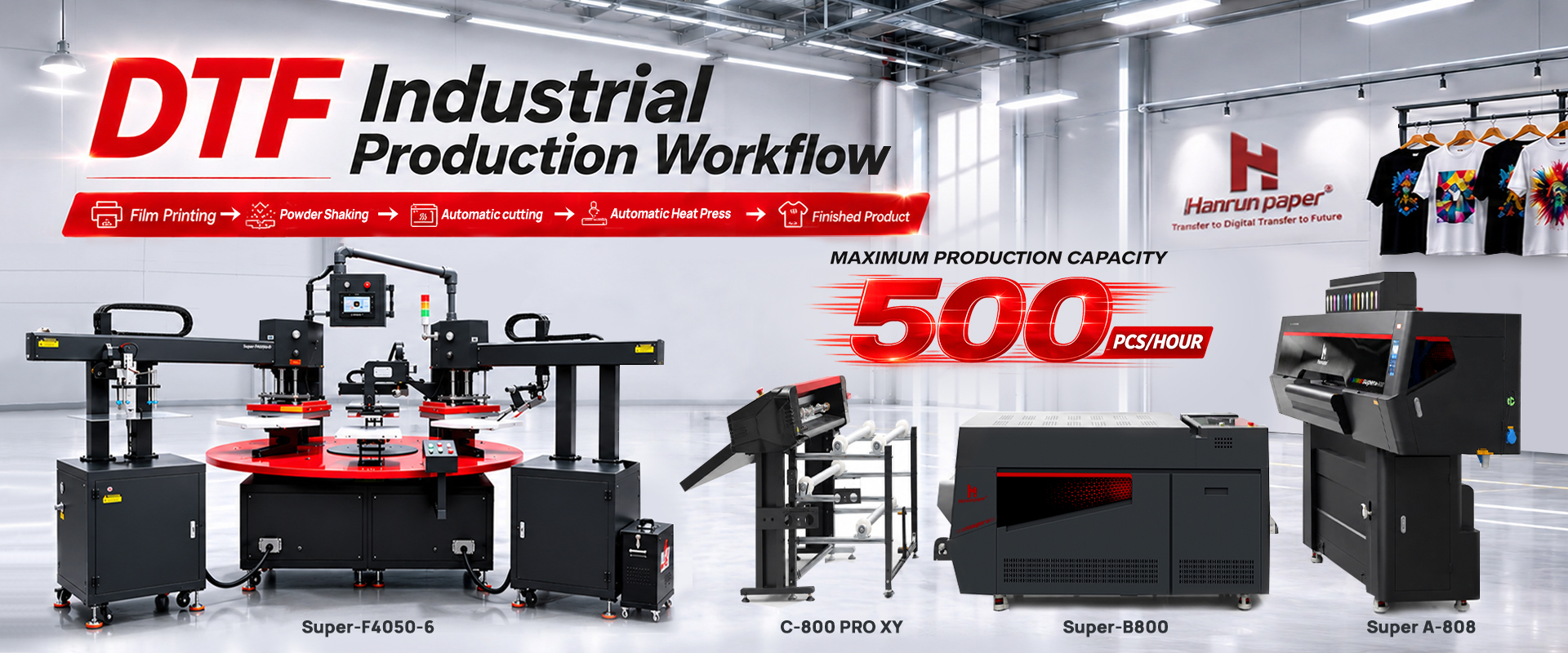
Its main features include:
✅Modular control design: Uses a Hoson mainboard for RIP control, with independently designed functional control boards.
✅Fast maintenance: Features a redundant control architecture. If an interface group develops a problem, the corresponding control board can be replaced within 15 minutes to restore production without replacing the mainboard.
✅Quality components: Equipped with Sanfu capping stations, THK linear guide rails, Delixi electrical components, and other quality parts.
✅Intelligent functions: Includes automatic safety alarms, automatic ink stirring, dual-adjustment media feeding, front and rear heating, and a 3M antistatic exhaust film.
These features help simplify troubleshooting and reduce the impact of equipment maintenance on daily production.
| Production Requirements | Recommended Drive Solution | Recommended Models |
|---|---|---|
| High-volume, 24-hour continuous production with extremely high precision requirements | Magnetic levitation linear motor | UV-H2513, UV-H9060 (optional) |
| Small- to medium-volume production with limited budgets and a focus on cost-effectiveness | Traditional drive system (servo motor) | Super A-808, EVO Series |
| Printing 3D objects and irregular surfaces | Linear motor + visual positioning | UV-H9060 (optional linear motor) |
| DTF printing and personalized customization | Traditional drive system (stable and reliable) | Super A-808 Series, EVO Series |
Not necessarily.
Magnetic levitation linear motors offer advantages in direct drive, reduced mechanical backlash, and lower mechanical wear. They are better suited to applications requiring fast response, high positioning accuracy, and long-term operational stability.
Traditional screw and belt drive systems are based on mature technology and offer relatively controllable costs. With proper design and maintenance, they can also meet the requirements of many industrial printing applications.
For most DTF printing and personalized customization applications, properly configured traditional drive systems can fully meet everyday production requirements.
For example, Hanrun Paper's Super A-808 and EVO Series combine mature mechanical structures, quality components, and stable control systems to provide reliable printing solutions for customers.
Hanrun Paper provides a range of digital printing equipment based on different printing technologies, offering comprehensive one-stop digital printing solutions that cover printing machines, supporting consumables, software, and professional technical support. These solutions are designed to meet customers' actual production needs and improve overall printing efficiency.
Whether you are considering the magnetic levitation linear motor technology of the UV-H2513 UV flatbed printer, the multifunctional 3D printing capabilities of the UV-H9060 multifunctional UV printer, or the Super A-808 and EVO Series DTF printers, Hanrun Paper aims to help you select the right digital printing equipment and configuration for your specific production requirements.
Choosing the right printing equipment involves more than comparing drive technologies or machine specifications. It means investing in a complete digital printing production solution that integrates equipment, consumables, software, and technical support to ensure reliable operation and support your business growth over the long term.

